Pause carousel
Play carousel
Executive Summary
The Procurement Reform (Scotland) Act 2014 (PRA) requires any public organisation with an estimated annual regulated spend of £5 million or more to develop a procurement strategy and review it annually. This requirement took effect from 31 December 2016. Organisations (including Higher Education (HE) and Further Education (FE) institutions) required to develop and publish a procurement strategy were also mandated to publish an Annual Procurement Report (APR), reflecting on the relevant reporting period of the procurement strategy.
This report covers the period from 1 August 2024 to 31 July 2025 and addresses performance and achievements in delivering Abertay University’s organisational procurement strategy.
The development of the procurement strategy was the outcome of consultation and discussion with internal and external stakeholders who have an interest in the institutional approach to procurement and its impact. Stakeholder engagement will also feature in the annual assessments of the achievement of regulatory compliance, the strategic objectives of the institution, value for money [defined as the best balance of cost, quality and sustainability] and delivery against the institution’s broader aims and objectives, in line with Scotland's National Outcomes. This process of review and reporting will inform any adjustments to the procurement strategy deemed necessary to secure future performance improvements and to respond to the economic, political, and financial influences to which the institution may need to adapt.
Abertay University Procurement Strategy is currently under review to align with the aims and objectives of the Public Procurement Strategy for Scotland, which provides a high-level vision for Scottish public procurement. The revised strategy will support the overarching objectives of public procurement, which are:
• Good for Business and their Employees
• Good for Places and Communities
• Good for Society
• Open and Connected
The revised procurement strategy due for publication late 2025 will also seek to complement the University’s Strategic Plan.
As part of the Sustainable Procurement Duty, this report will summarise efforts made to improve the economic, social and environmental well-being of our area, particularly how procurement has contributed to the response to the global climate emergency.
Abertay University has analysed third-party expenditure and has identified that over the period covered by this report; the following expenditure has occurred:
• UK regulated procurements [goods and services worth more than £179,087; works worth more than £4,477,174 ] amounted to £5,041,815. There were 7 such procurements completed.
• Lower value regulated procurements’ [goods and services worth more than £50,000, works worth more than £2 million] amounted to £804,453. There were 10 such procurements completed.
More detailed information on the regulated procurements, sorted into procurement categories, is provided in Sections 1 and 2 and in Annex A of this report.
Abertay University had 441 active suppliers during the reporting period of which 254 are recorded as SMEs. 5 SMEs featured in the award of regulated procurements during the period.
The total non-pay expenditure was £11,708,373 made up of £1,247,251 in capital expenditure, £7,646,441 in regulated expenditure (where supplier spend is more than £50,000) and £2,814,681 in non-regulated expenditure.
The University optimises the use of national, sectoral, local, or regional collaborative contracts and frameworks. This significantly reduces the number of resource-intense formal local tenders and the associated burdens of risk, as well as enhances cash/non-cash savings and contract & supplier management. Approximately 46% of the University’s spend went through collaborative agreements during the reporting period.
The Procurement team successfully transferred under TUPE from APUC to Abertay in March 2025, further embedding procurement capability within the University.
The remainder of this report comprises five sections:
Section 1: Summary of Regulated Procurements Completed
Section 2: Review of Regulated Procurement Compliance
Section 3: Community Benefit Summary
Section 4: Supported Businesses Summary
Section 5: Future Regulated Procurements Summary
Section 6: Sustainability Summary
Abertay University strongly believes in conducting its procurements in an open and inclusive manner with procurement objectives aligned to the University’s Strategic Plan.
The detailed summary of regulated procurements completed is set out in Annex A. That information, coupled with the publication of the institutional Contracts Register and the systematic use of Public Contracts Scotland and Quick Quotes where appropriate, provides complete visibility of the University’s procurement activity over the reporting period.
Pages 12 and 13 of this document set out further information on lower value regulated procurements completed and UK regulated procurements completed. These are separated into contract categories, distinguishing collaborative contracts from institutional ones.
For each completed regulated procurement the information provided shows:
• the date of award
• the start dates
• the category subject matter
• the name of the supplier
• the estimated value of the contract (total over contract period)
• whether the contract collaborative or institution-owned
• the end date provided for in the contract or a description of the circumstances in which the contract will end.
• whether the supplier is an SME or supported business
This transparency ensures compliance with the Procurement Reform (Scotland) Act 2014 and supports stakeholder confidence in governance arrangements.
Where appropriate, the University makes use of collaborative contracts to deliver improved contract terms, supported contract and supplier management, sustainable procurement outcomes, and value for money (defined as the best balance of cost, quality, and sustainability).
Care is taken to ensure that the University appoints suppliers who are capable, reliable, and who can demonstrate that they meet high ethical standards and values in the conduct of their business.
During the period covered by this report, the University has endeavoured to undertake all its regulated procurements in compliance with UK Procurement Principles of equal treatment, non-discrimination, transparency, proportionality, and mutual recognition.
Successful delivery against the procurement strategy objectives is part of a continual improvement process that seeks incremental improvements to processes and outcomes over time.
|
Procurement Strategy Objective |
Objective Detail |
Annual Report Commentary on strategy delivery/compliance |
|
Improving Supplier Access to Public Contract |
To make procurement as straightforward as possible for the University and potential suppliers, in particular, to improve access for local suppliers and SME’s and to eliminate anything that does not add value to the procurement |
Abertay University procurement activity follows guidelines set out in the Scottish Procurement Journey ensuring consistency, and transparency. All regulated procurements are advertised on PCS, and the use of the Quick Quote facility for exercises that fall below the regulatory thresholds is made where appropriate. This approach maximises access to contract opportunities and ensures these are open to as many suppliers as possible. The University continues to engage with suppliers through early market engagement and feedback opportunities, ensuring clarity and proportionality in tender requirements. Procurement templates and workflows have been reviewed and refined to reduce administrative burden and improve accessibility for SMEs and local suppliers. |
|
Develop sound and useful procurement management information to measure and improve procurement, supplier performance, and to improve coordinated procurement planning. |
Spend analysis is undertaken using data from the University’s financial systems to support opportunity identification and forward planning. This provides a reliable evidence base for monitoring spend, supplier activity, and contract performance across Faculties and Directorates. Information available through the APUC Contracts Database and Institutional Dashboard provides a useful secondary source of benchmark data in relation to sector spend, savings, and collaborative activity. Together, these insights enable more strategic planning, improved coordination, and better-informed procurement decisions. While opportunities for Community Benefits and engagement with Supported Businesses remain limited due to the nature and value of the University’s regulated contracts, the Procurement Team continues to review these areas on a case-by-case basis and remains committed to identifying proportionate opportunities where feasible. |
|
|
Delivering Savings and Benefits |
To promote the delivery of value for money through good procurement practice and optimal use of procurement collaboration opportunities. |
Principles of Whole Life Costing, Quality, and Sustainability continue to underpin procurement decision-making to ensure that best value for money is achieved. Use of framework contracts and collaborative agreements remains the preferred approach where appropriate, enabling the University to leverage sector expertise and secure efficient and compliant routes to market. Opportunities for financial savings are modest given the scale of the University’s procurement activity; however, efficiencies have been realised through improved processes, standardised documentation, and effective use of collaborative frameworks. |
|
To work with our internal stakeholders and suppliers to ensure continued value, managed performance, and minimal risk throughout the life of contracts for the benefit of students and other external stakeholders. |
The University continues to promote effective contract and supplier management to ensure value is maintained throughout the contract lifecycle. Requirements are aggregated where appropriate to maximise leverage, reduce duplication of effort, and reduce administrative burden for staff across Faculties and Directorates. Stakeholder engagement is encouraged during specification development and throughout contract management to ensure performance, sustainability and risk considerations remain proportionate and aligned to the needs of students, staff and the wider institution. Procurement guidance, templates and direct support are available to colleagues involved in contract management, helping to strengthen governance, improve consistency, and ensure staff have the tools and advice needed to manage supplier performance confidently and effectively. |
|
|
Maximising Efficiency and Collaboration |
To work with Internal budget holders, academics and support service colleagues and suppliers to deliver innovation and best value to the University, through the continued development of effective and co-ordinated procurement processes. |
Procurement staff work collaboratively with end users and wider stakeholder groups to provide best practice advice and guidance aimed at maximising value and minimising risk in the provision of goods and services. Tender specifications and contracts are developed to ensure they meet institutional needs and are clearly understood and deliverable by the supply base. Process reviews undertaken during the reporting period have streamlined procurement workflows and documentation, improving consistency and efficiency. Collaboration with colleagues and APUC continues to enhance innovation and share best practice across the sector |
|
Deliver professional procurement training to our colleagues embedding procurement and contract management skills across the University. |
The Procurement Team continues to support professional development through participation in sector training programmes and online learning. The National Procurement Development Framework has been adopted to support competency mapping and development planning. Internal training materials and guidance have been updated to reflect current legislation, sustainability duties, and best practice in contract management. Staff involved in procurement and purchasing activities are provided with ongoing support to ensure compliance and value for money, with targeted sessions delivered to strengthen contract management capability across the University |
|
|
Embedding Sustainability in all we do |
To embed sound ethical, social, and environmental policies within the University’s procurement function and to comply with relevant Scottish and other pertinent legislation through compliance with the Sustainable Procurement Duty. |
The University embeds sustainability considerations throughout its procurement activity, ensuring compliance with the Sustainable Procurement Duty. Specifications reference recognised standards and labels to promote fair and ethical trading, and sector framework agreements provide assurance on supply chain practices, such as Electronics Watch monitoring in ICT procurement. The University contracts only with suppliers that comply with relevant legislation, and Fair Work practices are evaluated where proportionate. As an accredited Living Wage employer, Abertay encourages its supply base to adopt similar principles. Opportunities for Community Benefits and Supported Business engagement remain limited due to the scale and nature of the University’s contracts but are reviewed on a case-by-case basis. The Procurement Team continues to use FNT2030 worksheets to integrate sustainability into decision-making and reporting. The Community Wishes Programme with Dundee City Council is under review to finalise the legal framework confirming that liability for goods or services rests solely with the contractor, with the University acting only as a facilitator for supplier-led community contributions. |
The University has procurement processes and sign off arrangements that are consistent with the guidelines set out in the Procurement Journey and that have met the objectives and obligations mentioned above.
The University continues to consider community benefits in all regulated procurements and, in line with the Procurement Reform (Scotland) Act 2014, actively explores opportunities to improve the economic, social, and environmental well-being of the local area through inclusion of community benefit clauses where relevant and proportionate. Community benefits are formally required in procurements over £4m and may also be considered for lower-value contracts where appropriate.
Suppliers are invited to outline how they can support community benefit outcomes such as:
Although no new regulated contracts containing formal community benefit clauses were awarded during the reporting period, existing supplier commitments are contributing to the delivery of wider community outcomes.
Under the Minor Works contract, the contractor has embedded a Responsible Business Strategy focused on People, Partners and Planet, with national targets to enhance the lives of 10,000 people and generate £1bn in social value by 2030. Locally, their approach includes partnerships with organisations such as DYW, Skills Development Scotland and Dundee Utd Community Trust to support education, employability and skills development. Activities include curriculum support, volunteering, employability initiatives and in-kind contributions, with outcomes monitored through Social Value Plans (SVPs) and reported via the National TOMs Framework, ensuring transparency and alignment with national best practice.
In addition, a digital marketing supplier has committed to community benefit activities focused on enhancing digital skills, employability and knowledge sharing. Planned activities include participation in Abertay careers events, delivery of guest lectures and workshops on digital marketing and AI, provision of at least one structured internship annually, and the sharing of graduate-level opportunities with the University’s Careers Service. The supplier also supports wider client-led community benefit initiatives with a focus on education and digital skills development.
The University continues to engage with contractors and partners to explore proportionate community benefit opportunities within future procurements and to align activity with wider institutional priorities including sustainability, social value, and local economic impact.
Abertay University reviews appropriate procurements to determine whether subsequent contracts could be fulfilled by a Supported Business, whilst remaining compliant with UK and Scottish Procurement Legislation and ensuring value for money for the institution (using the only Supported Business register currently available and published by Ready for Business).
There were no contracts for supported businesses in the period covered by this report, and presently there are no contracts in place with a supported business. Opportunities will continue to be explored and identified as part of future contract strategies.
The University is keen to encourage competition by promoting optimal participation in its procurement process and achieve better value for money in its procurements. One method of achieving this is to give notice to suppliers of tendering opportunities that are expected to commence over the next two financial years after the period covered by this report.
In preparing this forward projection of anticipated regulated procurements, it is difficult to provide precise details of actual requirements. Over a forecast period of two years, it is very probable that circumstances and priorities will change, so the list of projected individual regulated procurement exercises outlined in this document should be viewed with this caveat in mind.
The information provided covers:
The University continues to integrate sustainability considerations across all procurement activities in line with the Sustainable Procurement Duty. Environmental, social, and ethical factors are embedded in tender development, evaluation, and contract management to ensure that purchasing decisions deliver value while supporting the University’s wider sustainability commitments.
During 2024/25, the procurement team delivered continued progress across several sustainability priorities:
· Secure document destruction and circular economy: In partnership with Avena Group, the University strengthened sustainability and GDPR compliance through secure document destruction, with all shredding material recycled within the UK, supporting circular-economy principles and reduced waste to landfill.
· ICT supply-chain responsibility: Continued use of Electronics Watch within ICT framework agreements provides assurance on ethical sourcing and human-rights standards throughout the supply chain.
· Carbon-aware travel and low-emission vehicles: Travel-management arrangements include carbon reporting by journey type to support emission monitoring and reduction. Eight employees have also joined the Low Carbon Vehicle Salary Sacrifice Scheme, further contributing to the University’s Net Zero 2038 target.
· Waste and recycling efficiency: Contract-management activity within waste and recycling services has improved resource recovery rates and reduced waste sent to landfill, complementing Estates carbon-reduction initiatives.
· Minor Works contract – Net Zero alignment: The University’s Minor Works contractor has embedded net zero and responsible procurement commitments within their 2030 Responsible Business Policy. Their approach includes achieving zero direct emissions from projects, offices, and fleet by 2030, with current carbon-management measures covering renewable energy, low-emission fleet transition, embodied-carbon reporting, and circular-economy waste practices. Their environmental management system and SmartWaste monitoring support delivery of low-carbon construction aligned to the University’s Net Zero 2038 target.
· Ethical AI and responsible data use: A digital marketing supplier has embedded robust ethical AI governance into service delivery, including pre-deployment audits to mitigate bias, data minimisation and privacy by design in line with UK GDPR and the Data Protection Act 2018, and human oversight of critical campaign decisions. Transparent reporting, clear explainability, and staff training on ethical AI principles ensure responsible technology use aligned with Abertay’s values and governance standards.
· Community engagement: The Procurement Team continues to work with Dundee City Council on the Community Wishes Programme, designed to facilitate supplier-led contributions to local initiatives once legal documentation is finalised to confirm that liability for goods and services rests with contractors.
The Procurement Team also continues to embed sustainability tools such as FNT2030 worksheets within all regulated procurements, ensuring consistent assessment of social, environmental, and economic impacts. Professional development remains a key enabler of progress, with two team members currently studying for Level 4 CIPS qualifications and the Head of Procurement undertaking an MSc in Accounting and Finance. This investment in skills and capability ensures that sustainable procurement remains integral to decision-making and supports continual improvement across the University.
List of Regulated Procurements Completed in the Reporting Period - 01/08/2024 – 31/07/2025
Compliant
|
Category Subject |
Supplier name |
Date of Award |
Owner: Cat A/B or C? |
Start Date |
End Date |
Value over initial contract period |
SME status |
Supported Business |
| Multichannel & SEO Agency | Anything is Possible | 04/06/2025 | C | 01/07/2025 | 30/06/2032 | £1,050,000 | Medium | No |
|
Leased Led Screen for Waters Edge |
VSS Limited |
14/11/2024 |
C |
06/01/2025 |
05/04/2029 |
£744,600 |
Medium |
No |
|
Minor Works |
Robertson Construction Tayside Limited |
20/12/2024 |
C |
13/01/2025 |
12/01/2029 |
£2,000,000 |
Medium |
No |
|
Investment Manager |
UBS Ltd |
27/03/2025 |
C |
01/04/2025 |
31/03/2034 |
£360,000 |
Large |
No |
|
Adobe Creative Cloud Licences |
Academia |
22/07/2024 |
B |
12/08/2024 |
11/08/2027 |
£292,058 |
Medium |
No |
|
Sustainable Furniture for Work & Learning Environments |
Azzurro |
01/10/2024 |
B |
01/10/2024 |
30/09/2028[1] |
£235,157 |
Large |
No |
|
Online Student Support 24/7 |
Studiosity Ltd |
30/07/2024 |
C |
22/08/2024 |
21/08/2027 |
£142,650 |
Micro |
No |
|
Minor Works Library |
Caledonia Contracts |
02/08/2024 |
C |
26/08/2024 |
25/12/2025 |
£100,000 |
Small |
No |
|
ePayment System |
Flywire Payments Ltd |
20/03/2025 |
C |
01/03/2025 |
29/02/2028 |
£94,500 |
Small |
No |
|
SDI Specialist Course Development |
Lyre Group |
03/10/2024 |
C |
07/10/2024 |
06/10/2025 |
£90,000 |
Micro |
No |
|
Survey Tool for Research |
Academia |
16/05/2025 |
B |
30/06/2025 |
29/06/2028 |
£84,897 |
Medium |
No |
|
IEEE IEL – Read only + green open access |
JISC Services Limited |
01/01/2025 |
B |
01/01/2025 |
31/12/2028 |
£73,000 |
Medium |
No |
|
Catering Provision |
Clarks Bakery Ltd |
16/01/2025 |
C |
06/01/2025 |
05/01/2030 |
£360,000 |
Medium |
No |
|
Evaluation Software |
Computacenter (UK) Limited |
30/01/2025 |
C |
01/02/2025 |
31/07/2027 |
£59,880 |
Large |
No |
|
Student Services – Target Connect |
GTI Futures Limited |
30/07/2024 |
C |
01/08/2024 |
31/01/2027 |
£58,240 |
Medium |
No |
|
Elsevier Read & Publish |
JISC Services Limited |
23/09/2024 |
B |
23/09/2024 |
22/12/2025 |
£51,286 |
Medium |
No |
|
Research Audit |
Henderson Loggie LLP |
21/01/2025 |
C |
03/02/2025 |
02/02/2030 |
£50,000 |
Medium |
No |
[1] Azzurro in the process of appointing a liquidator and have ceased trading. No orders where effected, Centre of Expertise assessing impact and reviewing solution to national framework. Abertay carrying out independent review of framework to assess route to market.
Non-Compliant
There were no non-compliant regulated procurements undertaken or completed in the reporting period.
List of Regulated Procurements with Community Benefit Requirements Fulfilled
There were no regulated procurements with community benefit requirements fulfilled during the reporting period.
List of Regulated Procurements placed with Supported Businesses
There were no regulated procurements placed with Supported Businesses during the reporting period.
List of Regulated Procurements planned to commence in next two Financial Years 2025/26 & 2026/27
*Subject to external funding
|
Category Subject Matter (Title/Desc) |
New, Extend or re-let |
Notice Publication Date |
Forecast Contract Award Date |
Forecast Start Date |
End Date |
Estimated Contract Value |
Category |
|
Insurance Covers |
Re-Let |
N/A |
01/07/2025 |
01/08/2025 |
31/07/2028 |
£680,000 |
A |
|
Blinds for Library |
New |
12/10/2025 |
15/12/2025 |
06/01/2026 |
05/01/2030 |
£82,000 |
C |
|
Print Services |
Re-Let |
01/02/2025 |
01/10/2025 |
01/12/2025 |
30/11/2028 |
£200,000 |
C |
|
Building Maintenance Services |
New |
06/08/2025 |
01/10/2025 |
10/11/2025 |
09/11/2028 |
£360,000 |
C |
|
Fully Managed Payroll & Pension Service |
New |
19/08/2025 |
14/10/2025 |
03/11/2025 |
02/11/2028 |
£265,000 |
C |
|
Oracle Managed Service |
Re-Let |
N/A |
01/11/2025 |
27/11/2025 |
26/11/2028 |
£90,000 |
B |
|
Legal Services |
Re-Let/Extend |
N/A |
01/12/2025 |
01/02/2026 |
31/01/2028 |
£200,000 |
B |
|
Elsevier Read and Publish (SHEDL) |
Re-Let |
N/A |
23/12/2025 |
23/12/2025 |
22/12/2026 |
£60,000 |
B |
|
Springer Nature Read & Publish |
Re-Let |
N/A |
01/01/2026 |
01/01/2026 |
31/12/2028 |
£67,000 |
B |
|
Sciencedirect Freedom Collection |
Re-Let |
N/A |
02/01/2026 |
02/01/2026 |
01/01/2029 |
£195,996 |
A |
|
Microsoft Azure Cloud Consumption |
Re-Let |
N/A |
01/10/2025 |
01/02/2026 |
31/01/2029 |
£405,000 |
B |
|
Multi-functional Devices (MFD) |
Re-Let |
N/A |
31/01/2026 |
01/07/2026 |
30/06/2031 |
£175,000 |
B |
|
Oracle Support for Perpetual Licences |
Re-Let |
N/A |
01/03/2026 |
30/04/2026 |
29/04/2029 |
£51,000 |
B |
|
Condition Survey |
Re-Let |
N/A |
06/03/2026 |
06/04/2026 |
05/04/2029 |
£252,000 |
B |
|
Energy Centre* |
New |
01/11/2025 |
01/07/2026 |
01/08/2026 |
31/05/2029 |
£25,000,000 |
C |
|
Current Research Information System |
Re-Let/Extend |
01/11/2025 |
01/04/2026 |
01/05/2026 |
30/04/2030 |
£160,000 |
C |
|
Electricity |
Re-Let |
N/A |
01/04/2026 |
01/04/2026 |
31/03/2031 |
£4,100,000 |
A |
|
Enterprise Back Up Solutions covering On Premise Systems and Microsoft 365 |
Re-Let |
N/A |
30/04/2026 |
30/04/2026 |
29/04/2029 |
£168,000 |
B |
|
Confectionery, Snacks and Soft Drinks |
Re-Let |
N/A |
01/05/2026 |
01/07/2026 |
30/06/2029 |
£225,000 |
B |
|
Travel Management Services |
Re-Let/Extend |
N/A |
01/06/2025 |
01/09/2026 |
31/08/2029 |
£930,000 |
B |
|
Graduation Events & Services |
Re-Let/Extend |
01/02/2026 |
01/06/2026 |
01/06/2026 |
31/05/2029 |
£180,000 |
C |
|
Virtual Learning Environment |
Re-Let/Extend |
N/A |
01/06/2026 |
01/08/2026 |
31/07/2029 |
£120,000 |
B |
|
Installation and Maintenance of AV Equipment & Digital Signage |
Re-Let |
N/A |
01/06/2026 |
01/07/2026 |
30/06/2029 |
£270,000 |
B |
|
HR/Payroll System Renewal |
Re-Let |
N/A |
30/06/2026 |
30/06/2026 |
39/06/2031 |
£285,000 |
B |
|
Facilities Management System |
Re-Let |
N/A |
01/07/2026 |
28/07/2026 |
27/07/2030 |
£200,000 |
A |
|
JISC Core Learning Analytics |
Re-Let |
N/A |
01/07/2026 |
01/08/2026 |
31/07/2029 |
£84,000 |
B |
|
Lift Maintenance |
Re-Let/Extend |
N/A |
01/08/2026 |
01/09/2026 |
31/08/2028 |
£100,000 |
B |
|
Apps Anywhere Licences |
Re-Let |
N/A |
14/08/2026 |
14/10/2026 |
13/10/2029 |
£92,000 |
A |
|
Sustainable Furniture |
Re-Let |
N/A |
01/09/2026 |
01/10/2026 |
30/09/2030 |
£230,000 |
B |
|
Business Source Complete Academic Database |
Re-Let |
N/A |
01/09/2026 |
01/10/2026 |
30/09/2029 |
£79,661 |
C |
|
International Student Marketing |
Re-Let |
01/02/2026 |
01/10/2026 |
01/10/2026 |
30/09/2029 |
£90,000 |
C |
|
Coach Hire |
Re-Let |
01/04/2026 |
20/10/2026 |
20/11/2026 |
19/11/2030 |
£50,000 |
C |
|
Microsoft Services – EES Licence Agreement |
Re-Let |
N/A |
01/11/2026 |
01/01/2027 |
31/12/2029 |
£245,141 |
B |
|
Hosting, Supporting and Maintenance for Abertay Website |
Re-Let/Extend |
N/A |
01/11/2026 |
01/01/2027 |
31/12/2028 |
£99,000 |
C |
|
Cloud Email Security Platform |
Re-Let |
N/A |
20/11/2026 |
04/12/2026 |
03/12/2029 |
£60,110 |
B |
|
Catering Provision |
Re-Let/Extend |
N/A |
01/12/2026 |
05/01/2028 |
04/01/2031 |
£180,000 |
C |
|
Minor Works |
Re-Let/Extend |
N/A |
01/12/2026 |
13/01/2027 |
12/01/2030 |
£1,500,000 |
C |
|
Natural Gas |
Re-Let |
N/A |
01/03/2027 |
01/04/2027 |
31/03/2030 |
£845,000 |
A |
|
Water & Waste Water |
Re-Let/Extend |
N/A |
01/03/2027 |
01/04/2027 |
31/03/2030 |
£240,000 |
A |
|
Library Management System |
Re-Let |
N/A |
01/05/2027 |
30/06/2027 |
29/06/2030 |
£300,000 |
B |
[NOTE: reference to contract is also to be construed as meaning a Framework Agreement]
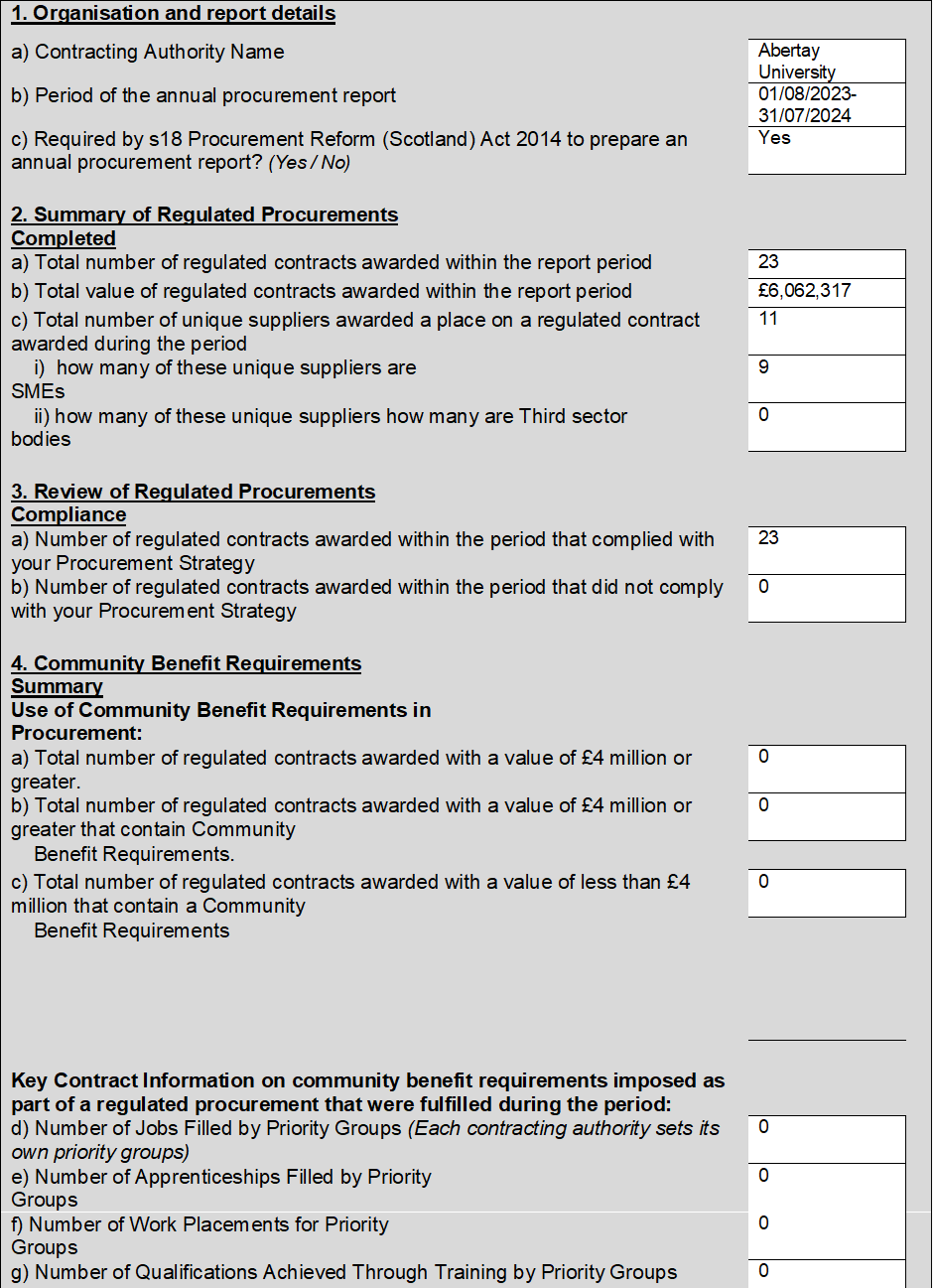
|
1. Organisation and report details |
|
|
|
|
|
|
a) Contracting Authority Name |
|
|
|
|
Abertay University |
|
b) Period of the annual procurement report |
|
|
|
|
01/08/2024-31/07/2025 |
|
c) Required by s18 Procurement Reform (Scotland) Act 2014 to prepare an annual procurement report? (Yes / No) |
Yes |
||||
|
|
|
|
|
|
|
|
2. Summary of Regulated Procurements Completed |
|
|
|
|
|
|
a) Total number of regulated contracts awarded within the report period |
|
17 |
|||
|
b) Total value of regulated contracts awarded within the report period |
|
£5,846,268 |
|||
|
c) Total number of unique suppliers awarded a place on a regulated contract awarded during the period |
6 |
||||
|
i) how many of these unique suppliers are SMEs |
|
|
|
|
4 |
|
ii) how many of these unique suppliers how many are Third sector bodies |
|
0 |
|||
|
|
|
|
|
|
|
|
3. Review of Regulated Procurements Compliance |
|
|
|
|
|
|
a) Number of regulated contracts awarded within the period that complied with your Procurement Strategy |
17 |
||||
|
b) Number of regulated contracts awarded within the period that did not comply with your Procurement Strategy |
0 |
||||
|
|
|
|
|
|
|
|
4. Community Benefit Requirements Summary |
|
|
|
|
|
|
Use of Community Benefit Requirements in Procurement: |
|
|
|
|
|
|
a) Total number of regulated contracts awarded with a value of £4 million or greater. |
0 |
||||
|
b) Total number of regulated contracts awarded with a value of £4 million or greater that contain Community |
0 |
||||
|
Benefit Requirements. |
|
||||
|
c) Total number of regulated contracts awarded with a value of less than £4 million that contain a Community |
3 |
||||
|
Benefit Requirements |
|
||||
|
|
|
||||
|
Key Contract Information on community benefit requirements imposed as part of a regulated procurement that were fulfilled during the period: |
|
||||
|
d) Number of Jobs Filled by Priority Groups (Each contracting authority sets its own priority groups) |
0 |
||||
|
e) Number of Apprenticeships Filled by Priority Groups |
|
|
|
|
0 |
|
f) Number of Work Placements for Priority Groups |
|
|
|
|
0 |
|
g) Number of Qualifications Achieved Through Training by Priority Groups |
0 |
||||
|
h) Total Value of contracts sub-contracted to SMEs |
|
|
|
|
0 |
|
i) Total Value of contracts sub-contracted to Social Enterprises |
|
|
|
|
0 |
|
j) Total Value of contracts sub-contracted to Supported Businesses |
|
|
|
|
0 |
|
k) Other community benefit(s) fulfilled |
|
|
|
|
0 |
|
|
|
|
|
|
|
|
5. Fair Work and the real Living Wage |
|
|
|
|
|
|
a) Number of regulated contracts awarded during the period that have included a scored Fair Work |
|
0 |
|||
|
criterion. |
|
|
|||
|
b) Number of unique suppliers who have committed to pay the real Living Wage in the delivery of a regulated |
4 |
||||
|
contract awarded during the period. |
|
||||
|
c) Number of unique suppliers who are accredited Living Wage employers and were awarded a regulated |
0 |
||||
|
contract awarded during the period. |
|
||||
|
d) Number of unique suppliers who have signed up to the Scottish Business Pledge and were awarded a |
0 |
||||
|
regulated contract awarded during the period. |
|
||||
|
|
|
|
|
|
|
|
6. Payment performance |
|
|
|
|
|
|
a) Number of valid invoices received during the reporting period. |
|
|
|
|
3965 |
|
b) Percentage of invoices paid on time during the period (“On time” means within the time period set out in |
81% |
||||
|
the contract terms.) |
|
||||
|
c) Number of regulated contracts awarded during the period containing a contract term requiring the prompt |
0 |
||||
|
payment of invoices in public contract supply chains. |
|
||||
|
d) Number of concerns raised by sub-contractors about the timely payment of invoices within the supply chain |
0 |
||||
|
of public contracts. |
|
||||
|
|
|
|
|
|
|
|
7. Supported Businesses Summary |
|
|
|
|
|
|
a) Total number of regulated contracts awarded to supported businesses during the period |
|
0 |
|||
|
b) Total spend with supported businesses during the period covered by the report, including: |
0 |
||||
|
i) spend within the reporting year on regulated contracts |
|
|
|
|
0 |
|
ii) spend within the reporting year on non-regulated contracts |
|
0 |
|||
|
|
|
|
|
|
|
|
8. Spend and Savings Summary |
|
|
|
|
|
|
a) Total procurement spend for the period covered by the annual procurement report. |
£11,708,373 |
||||
|
b) Total procurement spend with SMEs during the period covered by the annual procurement report. |
£6,633,766 |
||||
|
c) Total procurement spend with Third sector bodies during the period covered by the report. |
0 |
||||
|
d) Percentage of total procurement spend through collaborative contracts. |
|
46% |
|||
|
|
|
|
|
|
|
|
e) Total targeted cash savings for the period covered by the annual procurement report |
|
Local target not set |
|||
|
i) targeted cash savings for Cat A contracts |
|
|
|
|
- |
|
ii) targeted cash savings for Cat B contracts |
|
|
|
|
- |
|
iii) targeted cash savings for Cat C contracts |
|
|
|
|
- |
|
|
|
|
|
|
|
|
f) Total delivered cash savings for the period covered by the annual procurement report |
|
||||
|
i) delivered cash savings for Cat A & B contracts |
|
|
|
|
£118,981 |
|
|
|
|
|
|
|
|
ii) delivered cash savings for Cat C contracts |
|
|
|
|
£95,756 |
|
|
|
|
|
|
|
|
g) Total non-cash savings value for the period covered by the annual procurement report |
£754,044 |
||||
|
|
|
|
|
|
|
|
9. Future regulated procurements |
|
|
|
|
|
|
a) Total number of regulated procurements expected to commence in the next two financial years |
40 |
||||
|
b) Total estimated value of regulated procurements expected to commence in the next two financial years |
£38,915,908 |
||||
A, B, C and C1 Contracts (Who buys what?)
| Category A | Collaborative Contracts available to all public bodies • Scottish Procurement |
| Category B | Collaborative Contracts available to public bodies within a specific sector • Scottish Procurement • Advanced Procurement for University and Colleges (APUC) • Scotland Excel • NHS National Procurement |
| Category C | Local Contracts for use by individual public bodies |
| Category C1 | Local or regional collaborations between public bodies |
APUC’s Code of Conduct - APUC and its client community of colleges and universities are committed to carrying out procurement activities in an environmentally, socially, ethically, and economically responsible manner and to entering into agreements and contracts with suppliers that share and adhere to its vision. To demonstrate this commitment, current and potential suppliers are asked to acknowledge their compliance with the principles of the APUC Supply Chain Code of Conduct with respect to their organisation and their supply chain.
BT14 – Sustainability Based Benefits - Sustainability benefits where costs are not normally relevant can be reported but will normally be described in narrative form, including but not limited to the following areas:
· Reduction in waste – packaging and/or further use of residue from processes, etc.
· Reduction in consumption - use of raw materials (consumables, utilities, etc.)
· Recycling and/or reuse of products
· Enhanced reputation and/or marketing opportunities
· Community Benefits delivery
· Carbon Reduction
· Social, equality and/or environmental improvements Category Subject is a collection of commodities or services sourced from the same or similar supply base, which meet a similar consumer need or which are interrelated or substitutable.
Community Benefits are requirements that deliver wider benefits in addition to the core purpose of a contract. These can relate to social, economic, and or environmental. Benefits. Community Benefits clauses are requirements that deliver wider benefits in addition to the core purpose of a contract. These clauses can be used to build a range of economic, social, or environmental conditions into the delivery of institutional contracts.
Contracts Registers typically provide details of the procurement exercise to capture key information about the contract (the goods and services, values, date started, expiry date, procurement category, etc).
Cost Avoidance is the act of eliminating costs or preventing their occurrence in the first place. It tends not to show up on, but materially impacts, the bottom-line cost and is normally referred to as a “soft” cost saving i.e. negating supplier requests to increase costs, procuring services/goods/ works under budget, and obtaining prices lower than the market average/median.
Contract management or contract administration is the management of contracts made with customers, suppliers, partners, or employees. Contract management activities can be divided into three areas: service delivery management; relationship management; and contract administration.
UK regulated procurements are those whose values require that they are conducted in compliance with the Public Contracts (Scotland) Regulations 2015 and the Procurement Reform (Scotland) Act 2014.
Flexible Framework Self-Assessment Tool (FFSAT) enables measurement against various aspects of sustainable procurement.
Hub (Spikes Cavell) - The Scottish Procurement Information Hub is provided by Spikes Cavell as a spend analysis tool allowing organisations to: -
◾Identify non-pay spend on external goods and services
◾Identify key suppliers and how many transactions are made with each
◾Highlight common spend across suppliers and categories
◾Identify spend with SMEs and/or local suppliers
This information means that individual organisations and Centres of Expertise can identify where collaborative opportunities might exist and where transactional efficiencies could be made. For more information, visit the Scottish Government's Hub page.
Hunter - Hunter has been developed by the eSolutions team. It is a database solution that uses standard Microsoft packages (Access and SQL Server) enabling organisations to effectively monitor and report on collaborative contracting activities. As a solution, it is operational within the HE/FE sector in Scotland and is also being utilised by the HE consortia in England and Wales that also provide collaborative contracting services to the sector. Hunter has a multi-level structure which allows consortia to share collaborative agreements, make them visible to their member organisations, and in turn enabling them to record their own contracts.
Institutional Dashboard - This is the area within the APUC Buyers Portal being developed by the APUC eSolutions team, providing easy access to institutions’ key management reporting data being recorded centrally through Hunter. The dashboard currently hosts key regulatory procurement information on Contracts Registers, forward contracting plans, expenditure reporting, and APR Data. The list of reports is planned to expand to cover savings and PCIP dashboard data.
Lotting - The Public Contracts (Scotland) Regulations 2015 encourage the use of lots (regulation 47), to promote competitiveness and to facilitate the involvement of SMEs in the public procurement market by considering the appropriateness of dividing contracts into lots to create smaller contracts
UK thresholds - The present thresholds are (net of VAT): for Supply and Services Contracts, £177,897; for Works Contracts £4,447,447. Public contracts (UK) thresholds are revised every 2 years – this is next due on 01/01/2026.
Output Specification - Requirements are set out in terms of what you want to achieve, leaving the tenderers to decide on how they will deliver those requirements. This can lead to innovation by the tenderers. The services detailed in the output specification should be capable of objective assessment so that the performance of the supplier can be accurately monitored.
Prioritisation - The Sustainable Public Procurement Prioritisation Tool which is a tool to aid all procuring organisations across the Scottish Public Sector, designed to bring a standard structured approach to the assessment of spend categories.
Procurement Journey is public procurement toolkit with guidance and templates on the procurement process to facilitate a standardised approach to the market and contract and supplier management.
Procurement & Commercial Improvement Programme (PCIP) replaced the previous Procurement Capability Assessment (PCA) and focuses on the policies and procedures driving procurement performance and, more importantly, the results they deliver.
PCS (Public Contracts Scotland) is the national advertising portal used to advertise all public sector goods, services, or works contract opportunities.
PCS-Tender is the national eTendering system and is centrally funded by the Scottish Government. The system is a secure and efficient means for buyers and suppliers to manage tender exercises online. The standard templates enable buyers to create consistent tender documentation.
Segmentation is the division and grouping of suppliers or contracts in relation to spend and its criticality to business.
Small and Medium Sized Enterprises (SMEs) encompass:
• Micro enterprises: enterprises which employ fewer than 10 persons and whose annual turnover and/or annual balance sheet total does not exceed £1.57 million.
• Small enterprises: enterprises which employ fewer than 50 persons and whose annual turnover and/or annual balance sheet total does not exceed £7.86 million.
• Medium enterprises: enterprises which are neither micro nor small, which employ fewer than 250 persons and which have an annual turnover not exceeding £39.28 million, and/or an annual balance sheet total not exceeding £33.78 million.
Social Enterprises are revenue-generating businesses with primarily social objectives whose surpluses are reinvested for that purpose in the business or in the community, rather than being driven by the need to deliver profit to shareholders and owners.
Supply Chain encompasses all activities, resources, products, etc. involved in creating and moving a product or service from the supplier to the procurer.
Supply Chain Management Programme (Sustain) is the APUC supply chain sustainability web portal, a central hub where sector suppliers can complete and store sustainability compliance data. The portal is the core supply chain sustainability tool supporting HE and FE institutions and their suppliers in delivering a transparent, environmentally positive, ethical, and socially responsible supply chain
Supported business means an economic operator whose main aim is the social and professional integration of disabled or disadvantaged persons, and where at least 30% of the employees of the economic operator are disabled or disadvantaged persons.
Supported employment programme means an employment programme operated by an economic operator, the main aim of which is the social and professional integration of disabled or disadvantaged persons, and where at least 30% of those engaged in the programme are disabled or disadvantaged persons.
Sustainable Procurement A process whereby organisations meet their needs for goods, services, works, and utilities in a way that achieves value for money on a whole life basis and generates benefits, not only for the organisation but also for society, the economy, and the environment.
Third-Party Expenditure is calculated based upon the total value of invoices paid per annum, excluding VAT, to all suppliers for the purchase of goods and services. It is defined as including:
• Goods – tangible products such as stationery, which are often also known as supplies.
• Services – provision of an intangible product such as refuse collection, elderly home care, whether carried out internally or externally.
• Works – including construction works and utilities – energy costs.
It excludes employee costs, non-cash expenditure (e.g. depreciation), grants, trust payments, and other non-controllable payments to other publicly funded bodies but should include spending on agency staff, capital expenditure, and programme spend on commodities and services.